


Where to Buy Authentic NCAA Hoodies in 2026
Table of Contents
- What Makes an NCAA Hoodie Authentic
- How to Identify Officially Licensed College Gear
- Best Online Stores for College Fan Accessories
- Sizing and Fit Comparison for NCAA Hoodies
- Fabric Technology Breakdown: What to Look For
- Beyond Hoodies: Matching Fan Gear and Accessories
- Frequently Asked Questions
Last Updated: September 10, 2026
What Makes an NCAA Hoodie Authentic
Authentic NCAA hoodies are manufactured under a formal license from a university or its licensing agent, carrying approved team branding and verifiable licensing marks. The gap between genuine and fake comes down to paperwork as much as fabric.
Universities grant rights through trademark offices and collective licensing bodies, and every approved product carries marks tracing back to that chain (uspto.gov). A counterfeit copies the logo, not the license.
This guide covers where to buy authentic NCAA hoodies, how to verify them, and how sizing and fabric affect the authentic NCAA hoodies you get.
Officially Licensed vs. Counterfeit
The difference between an officially licensed hoodie and a counterfeit is legal authorization, not visual similarity. A counterfeit can replicate a team logo accurately, but not the licensing documentation.
That documentation shows up in specific places:
- A hang tag listing the manufacturer and the licensing entity
- A holographic sticker, often with a serial number or tamper-evident design
- A woven or printed label inside the collar identifying the licensee
- Consistent team colors matched to official brand standards
Counterfeiters typically get one or two of these right and miss the rest: a missing hang tag, a flat printed square instead of a hologram, or an interior label naming a manufacturer with no licensing relationship to the school.
A common mistake is judging authenticity by feel alone. Weight and softness vary widely across legitimate manufacturers, so texture is a weak signal. Documentation is the strong one.
How to Identify Officially Licensed College Gear
Identifying officially licensed college gear means checking three things in order: the hang tag, the holographic sticker, and the construction details. Each layer is harder to fake than the last, so working in sequence filters out most counterfeits.
The U.S. Patent and Trademark Office trademark basics guide explains how trademark licensing works in general terms, which helps explain why legitimate gear carries so much documentation. Universities protect their marks aggressively, and licensees are contractually required to display that protection on the product.
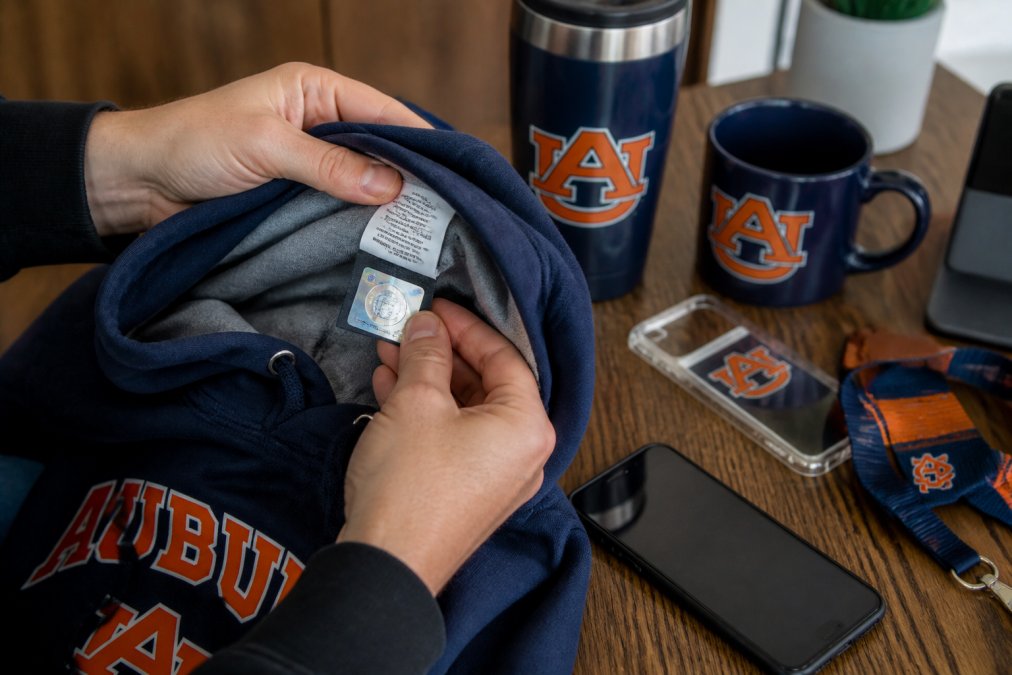
Check the Hang Tag and Holographic Sticker
Start with the hang tag. Genuine merchandise carries a tag naming the manufacturer and referencing the licensing program, attached with a proper fastener rather than cheap string.
The holographic sticker is the second check. Tilt it under light. A real hologram shifts color and shows depth. A printed imitation stays flat no matter the angle.
Some licensing programs also include a serial number that can be checked with the licensing body. Where that option exists, use it. It takes a minute and settles the question.
Inspect Stitching, Logos, and Team Colors
Stitching quality separates licensed manufacturers from copycats more reliably than any other physical detail. Look for even spacing, clean seams, and no loose threads at stress points like the shoulders and hood attachment.
Logo placement matters too. Official logos sit straight, centered, and correctly proportioned; a tilted or stretched-looking logo is a warning sign.
Team colors are the third check. Universities publish official color specifications and licensees match them; counterfeits often drift toward a cheaper, slightly off shade, especially with less common color combinations.
Best Online Stores for College Fan Accessories
The safest places to buy college fan accessories are licensed specialty retailers and official university channels. Mass marketplaces mix genuine and counterfeit listings, sometimes on the same page, so the source matters as much as the product.
What separates a trustworthy seller from a risky one is not the storefront design. It is whether the seller can answer four questions before you enter payment information.
The Four-Question Seller Test
1. Can the seller name the licensing entity? Legitimate retailers reference the licensing program or the university's trademark office. If the only claim is "officially licensed" with no program named, treat it as unverified.
2. Does the product page show real tags and labels? Genuine listings show the hang tag, interior collar label, and holographic sticker. Listings with only rendered mockups or flat stock images are usually hiding their absence.
3. Is the return policy written in plain language? Look for a stated window, condition requirement, and process. Vague policies ("returns handled case by case") are a warning sign, because the seller controls the outcome.
4. Does the seller carry a coherent team roster? A store selling NCAA, MLB, NBA, NFL, and NHL merchandise under one roof is normal for a licensed specialty retailer. A store selling logos from dozens of unrelated brands with no licensing statement is not.
| What to Check | Why It Matters | Red Flag |
|---|---|---|
| Licensing statement | Confirms authorized seller status | No mention of licensing anywhere |
| Return policy | Protects against fit and authenticity issues | Returns refused or heavily restricted |
| Product photography | Shows real tags and labels | Only rendered or stock images |
| Team coverage | Indicates a real licensing relationship | Logos from dozens of unrelated brands |
| Payment methods | Determines your dispute options | Wire transfer or gift cards only |
Payment Methods and Dispute Options
The Federal Trade Commission guidance on buying online covers the practical side of this: credit and debit cards give you a dispute path through your card issuer, while wire transfers, gift cards, and peer-to-peer payment apps generally do not. If a seller only accepts methods with no chargeback option, that is the single strongest signal to walk away, regardless of how the product photos look.
A common pattern among counterfeit sellers is a deep discount on a hard-to-find team, a countdown timer, and a payment page offering only methods without buyer protection. Any one alone is not disqualifying; all three together is.
Why Specialty Retailers Beat General Marketplaces
General marketplaces mix inventory from thousands of sellers, and the platform is not the merchant, when an authenticity problem surfaces, you negotiate with an individual seller. Licensed specialty retailers carry their own inventory, publish their own return policy, and stand behind the licensing chain directly.
SOK Sports carries officially licensed merchandise across MLB, NBA, NFL, NHL, and NCAA teams, with personalized options on many items. For buyers who want college fan accessories, that breadth means one order and one return policy instead of five.
Sizing and Fit Comparison for NCAA Hoodies
Sizing is a common source of returns on apparel because there is no universal size standard across licensed manufacturers. A medium from one licensee can fit like a large from another, and two items with the same logo can be cut differently depending on the factory.
The fix is not to memorize a brand's sizing but to measure an item you already own and compare those numbers to the product page chart. That takes about two minutes and prevents most exchanges.
How to Measure a Hoodie You Already Own
Lay the apparel item flat and take four measurements with a soft tape measure:
- Chest width: Measure across the front, armpit to armpit, then double it. This is the number that determines whether the item closes comfortably.
- Body length: Measure from the highest point of the shoulder seam straight down to the bottom hem.
- Sleeve length: Measure from the center back of the collar, across the shoulder, and down to the end of the cuff.
- Shoulder width: Measure straight across from one shoulder seam to the other.
Write those numbers down, then compare them to the product page chart. If the chart lists garment measurements, you are comparing like to like. If it lists body measurements, add roughly two to four inches of ease for a standard fit, or four to six inches for a relaxed fit.
Athletic Fit vs. Standard Fit vs. Relaxed Fit
Most licensed apparel falls into one of three cuts, differing most in the chest and shoulders:
- Athletic fit: Tapered through the torso, narrower shoulders, shorter body. If you are between sizes, size up.
- Standard fit: Straight through the torso, moderate shoulder width, standard body length. The default cut for most licensed apparel.
- Relaxed fit: Wider through the chest and shoulders, longer body, roomier sleeves. Often labeled "big and tall" at the upper end of the size range.
A common mistake is ordering the same size across all three cuts. A medium athletic fit and a medium relaxed fit can differ by several inches at the chest for apparel.
Big and Tall, Youth, and Women's Cuts
Fit categories change measurements substantially, so match the cut to the wearer rather than sizing up or down.
- Big and tall: Longer body and sleeve length, wider shoulders, roomier through the torso. Standard sizes run short in the sleeves and ride up at the hem.
- Youth: Sized by age range with proportionally shorter sleeves and body. Youth XL is not equivalent to adult small, and sleeve length is usually the first thing to fail.
- Women's cuts: Tapered waist, narrower shoulders, shorter sleeve length. Women who prefer a relaxed fit often order the men's equivalent and size down one.
Layering Changes the Calculation
Layering changes the math. Apparel over a t-shirt needs standard ease; over a sweatshirt or flannel, add two to three inches at the chest and an inch or two in body length, or the hem will ride up when you raise your arms.
For game day layering, measure the thickest layer you intend to wear underneath, then add the hoodie's ease on top. Sizing up one step is usually right for layering apparel, but only if the sleeve length still works.
Sizing Accessories Is Easier
Building a game day setup around accessories removes fit as a variable. Drinkware, phone cases, tech and home-office accessories, baby and infant apparel, and display and fan-cave items are sized by function, not body. A tumbler fits a cupholder or it does not; a phone case fits a model or it does not. That removes the return risk that makes hoodie sizing frustrating.
If you are ordering apparel and accessories together, the accessories are the low-risk part of the cart. The apparel is the one to measure for.
Fabric Technology Breakdown: What to Look For
Fabric choice determines whether an apparel item gets worn weekly or sits in a drawer. Two categories cover most licensed college apparel: cotton fleece blends for everyday wear and performance fabrics for game day and outdoor use.
Cotton fleece, usually a cotton-polyester blend, offers warmth, a soft hand feel, decent shape retention, and clean printing and embroidery. The tradeoff is weight and slower drying.
Performance fabrics use moisture-wicking construction to move sweat away from the skin. They dry faster, pack smaller, and suit stadium conditions where temperatures swing, but typically cost more and feel less plush.
Look for these specifics on the label:
- Fabric weight, often listed in ounces per square yard for fleece
- Fiber content percentages, which indicate how the garment will wear
- Moisture-wicking or performance claims, which should appear on official product descriptions
- Care instructions, since performance fabrics often require different washing
A midweight fleece blend handles most situations; buyers attending games in cold or wet conditions should prioritize moisture-wicking construction in their apparel instead.
Beyond Hoodies: Matching Fan Gear and Accessories
Rounding out a game day setup is easier when one source carries complementary items. Matching accessories also solve the sizing problem, since drinkware, phone cases, and display pieces do not depend on fit.
Categories worth pairing with apparel:
- Drinkware: Tumblers, bottles, and mugs in team colors for the tailgate or the desk
- Phone cases: Team-branded protection that survives a season of use
- Tech and home-office accessories: Mousepads, desk organizers, and similar items for remote workers who want team colors at the workspace
- Baby and infant apparel: Team-branded pieces for registry gifts and new fans
- Display and fan-cave items: Pieces that anchor a dedicated space
SOK Sports stocks all of these categories, so a single order covers a full setup rather than five separate shipments.
Finding authentic college gear takes more care than it should, because counterfeiters copy what buyers see but not what they can verify. Check the tag, the hologram, and the stitching, and buy from a source that stands behind its licensing. SOK Sports carries officially licensed NCAA merchandise across drinkware, phone cases, and home-office accessories, with personalized options and team coverage spanning MLB, NBA, NFL, NHL, and NCAA programs. Subscribe to the SOK Sports newsletter for new arrivals and championship gear drops.
Frequently Asked Questions
How can I verify if an NCAA hoodie is authentic?
Check for an official licensing hang tag with a holographic sticker, inspect the stitching and logo embroidery for precision, and confirm team colors match official branding. Authentic NCAA hoodies also include a Collegiate Licensing Company (CLC) or university-specific mark. If the price seems too low or the logo looks blurry, it is likely counterfeit. Always buy from trusted retailers that specialize in officially licensed fan gear.
What are the signs of counterfeit college sports apparel?
Counterfeit college sports apparel often has misspelled team names, crooked logos, poor stitching, and missing licensing tags. The fabric may feel thin or stiff, and colors can be off. Another red flag is a price far below market average. Authentic gear from licensed retailers includes proper trademarks and consistent quality. If you are unsure, compare the item to official team photos or check the retailer's licensing credentials.
Where can I find authentic NCAA hoodies and matching fan accessories?
Look for established online fan shops that carry officially licensed merchandise across multiple teams. SOK Sports offers authentic NCAA hoodies plus matching accessories like drinkware, phone cases, and home-office items. These stores typically display licensing information and team logos clearly. Avoid marketplaces with third-party sellers unless you can verify their authorization. Sticking to a dedicated fan retailer reduces the risk of counterfeits.
Do officially licensed retailers carry more than just apparel?
Yes. Officially licensed retailers often stock a full range of fan gear beyond hoodies, including drinkware, phone cases, tech accessories, baby apparel, and fan-cave decor. This means you can outfit your home, office, and game-day setup with matching team-branded items. SOK Sports, for example, carries NCAA hoodies alongside accessories for everyday use, making it a one-stop shop for team pride.