


Best Sports Decor for Home Offices: 2026 Style Guide
Table of Contents
- Why Sports Decor Belongs in a Professional Home Office
- Sports Themed Desk Accessories That Keep You Organized
- How to Display Sports Memorabilia in an Office Without Clutter
- Professional Sports Office Decor Ideas for Adult Spaces
- Budget vs. Luxury: Tiering Your Sports Decor
- Ergonomic Sports Integration and Functional Storage
- Conclusion
- Frequently Asked Questions
Last Updated: September 13, 2026
Why Sports Decor Belongs in a Professional Home Office
The best sports decor for home offices solves one problem: how to show team loyalty without turning a workspace into a dorm room. This guide covers the pieces, placement rules, and styling choices that keep a fan-themed office professional.
A home office has to pass a video call test, hold up under client meetings, and still feel like yours. Sports decor can do all three when chosen deliberately rather than accumulated, the difference is scale, material, and restraint.
A framed print, a leather-wrapped desk pad, and one team-colored accent cushion read as intentional. Twenty bobbleheads on a shelf read as a storage problem.
Sports Themed Desk Accessories That Keep You Organized
Sports themed desk accessories work best when they earn their place functionally first. A team-branded item that also holds pens, charges a phone, or keeps a drink cold does two jobs at once, exactly what a small desk needs.
- Team-logo desk organizers: Pen cups, letter trays, and drawer dividers in a team color scheme keep surfaces clear while adding a subtle accent.
- Branded mouse pads and desk mats: A full-desk mat in a muted team palette protects the surface and anchors the visual theme.
- Charging stands and cable clips: Tech accessories with a team emblem solve cable clutter without looking gimmicky.
- Coasters and valet trays: Small, functional, and easy to swap if the color scheme changes.
Drinkware and Desk Organizers
Drinkware is the easiest entry point into a team-themed workspace because it is genuinely useful. An insulated tumbler or travel mug with a team logo sits on the desk all day and reads as personal, not decorative.
The detail most buyers miss: lid compatibility matters more than the logo. A tumbler that fits a standard car cup holder and has a leak-resistant lid gets used daily. One that does not ends up in a cabinet.
For organizers, match the desk's existing finish. A team-colored tray on a walnut desk looks deliberate; the same tray on a glass desk can look out of place.
Phone Cases and Tech Accessories
Phone cases are the most flexible piece of sports decor because they travel. A team-themed case works at the desk, in meetings, and on the commute, extending the theme without adding clutter.
Pair a case with a matching charging stand and the desk gets a coherent tech zone. The mistake is going too loud: pick one statement piece and keep the rest understated.
How to Display Sports Memorabilia in an Office Without Clutter
How to display sports memorabilia in an office comes down to one rule: group items by size, give each surface a single focal point, and let negative space do as much work as the objects. A signed ball, a framed photo, and a pennant on one shelf compete; spread across three shelves with breathing room, they become a collection.
Start by sorting memorabilia into three tiers:
| Tier | Item Type | Display Method | Clutter Risk |
|---|---|---|---|
| Small | Pins, cards, coins | Shadow box or tray | Low if grouped |
| Medium | Signed balls, pucks, mini helmets | Acrylic case or riser | Medium |
| Large | Framed photos, banners, signed prints | Wall mount or shelf | High if unanchored |
The tier system does the work: small items get grouped into one container, medium items get individual cases, and large items get wall space, freeing every horizontal surface for work.
The Three Rules That Keep a Display From Reading as Clutter
Most displays fail for one of three fixable reasons.
- One focal point per surface. A shelf, desktop, or wall section gets exactly one item that draws the eye; everything else is smaller and subordinate. Two items of equal visual weight cancel each other out.
- Consistent spacing. Small items sit roughly 2 to 3 inches apart inside a tray or case, medium items get 4 to 6 inches of clear space, and large wall pieces get at least 6 inches of wall between them and the next object. Uneven gaps make a collection look accidental.
- A neutral backdrop. Memorabilia reads best against a plain wall or a shelf in a wood, black, or white finish. Team-colored shelving behind team-colored objects flattens the whole display into one loud block.
Floating Shelves and Display Cases
Floating shelves are the single most effective tool for a sophisticated sports display. They hold memorabilia at eye level, keep the desk clear, and create the curated look that separates an adult office from a fan cave.
Three rules for floating shelves:
- Mount at consistent heights across a wall, not staggered randomly
- Leave at least one empty shelf section for breathing room
- Match shelf finish to the desk or trim, not to the team colors
Display cases do the same job for individual pieces. A clear acrylic case protects a signed ball and makes it look intentional; the same ball loose on a bookshelf looks like it was left there.
A standard acrylic case for a full-size ball runs roughly 4 to 5 inches on each side, and a mini helmet case closer to 6 to 7 inches wide (Challenge Validation). Measure the tallest and widest item before buying shelving, a shelf 1 inch too shallow forces you to rehang the whole wall.
Layout Patterns That Work in a Home Office
Three layouts cover almost every home office wall:
- The single anchor. One large framed piece centered above the desk, nothing else on that wall. Best for small offices and video-call backdrops.
- The triptych. Three same-size frames in a row, centers aligned at roughly 57 to 60 inches from the floor (nga.gov). Best for a long, narrow wall.
- The salon stack. One large piece flanked by two smaller pieces aligned to its vertical center. Best for a tall wall with high ceilings.
Pick one pattern per wall. Mixing patterns is the fastest way to make a curated collection look like a pile.
DIY Installation Tips for Memorabilia Displays
Installation is where most display projects go wrong, and it is almost always a wall-anchor problem. Framed prints, shelves, and cases add real weight to drywall.
- Locate studs before drilling and mark them with painter's tape
- Use toggle bolts for drywall sections with no stud behind them
- Keep heavy items within 12 inches of a stud line
- Level every shelf before loading it, not after
- Leave 18 to 24 inches between shelf rows for taller pieces
- Test load each shelf with the actual items before final tightening
A few mechanics worth knowing:
- Stud finders map a wall fast but can miss on plaster or lath. Confirm each mark with a thin finish nail before drilling.
- Toggle bolts spread load behind the drywall and hold far more than a plastic anchor. Use them for anything heavier than a small framed print.
- French cleats are the cleanest way to hang a heavy framed piece or loaded shelf: the cleat screws into studs and the wall carries the load.
- Adhesive strips are fine for lightweight items like pennants, but they fail in heat and humidity. Do not use them for anything with glass or metal.
Keeping the Display From Growing Into Clutter
The hardest part of a memorabilia display is not building it, it is stopping it. Displays often look great for six months, then absorb every new item until the wall is full.
Two habits prevent that:
- Cap the collection. Decide in advance how many pieces the display holds. When a new piece arrives, one leaves. Rotate rather than accumulate.
- Re-tier every season. Move one small item up to a medium case, or retire a piece to storage, so the display keeps its shape instead of flattening into a uniform row.
A display that stays curated gets looked at. One that fills every inch becomes wallpaper.
Professional Sports Office Decor Ideas for Adult Spaces
Professional sports office decor ideas for adult spaces share one trait: restraint. The room signals fandom through a few well-chosen pieces rather than covering every surface.
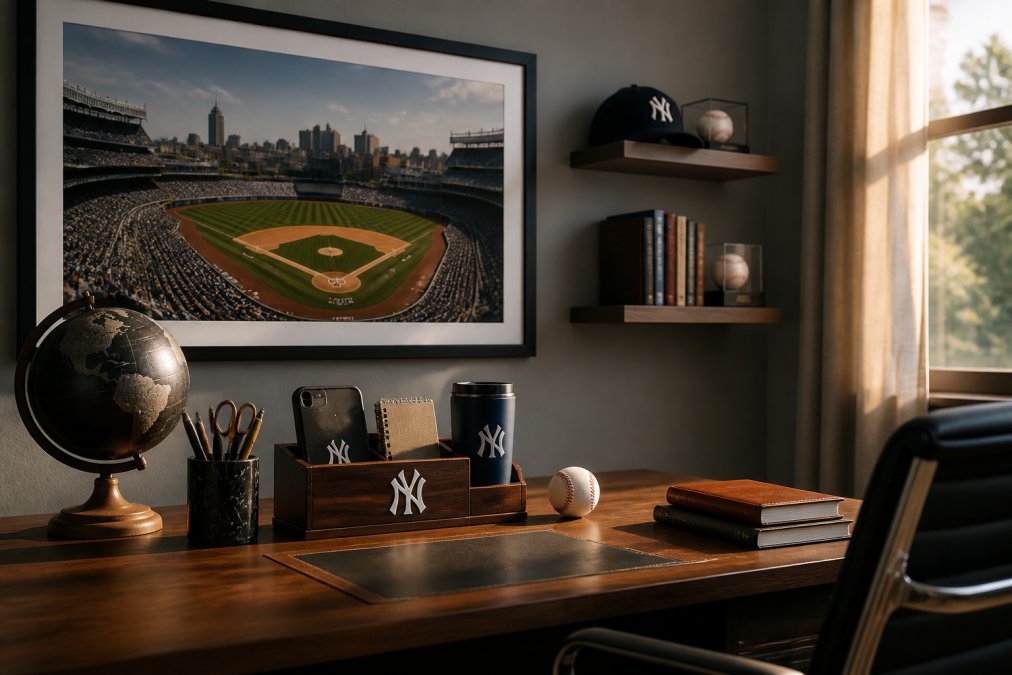
The formula that works: one large wall piece, one functional team item on the desk, one lighting accent, and a neutral base palette. That is it. Everything else is optional.
Wall Art and Motivational Prints
Wall art does the heaviest lifting in a sports-themed office because it covers the most visual area with the least physical clutter. One large framed print above the desk replaces five small items scattered around the room.
Motivational prints work particularly well here. A framed quote paired with a team color scheme reads as professional inspiration rather than fan merchandise. The trick is the frame. A quality frame in black, natural wood, or brushed metal elevates any print. A cheap frame undermines even a great piece.
Group prints in odd numbers. Three vertical prints in a row, or one large piece flanked by two smaller ones, creates a composition. Two prints side by side almost always look unfinished.
LED Lighting and Scoreboards
LED lighting and scoreboards are the piece most likely to tip a professional office into fan-cave territory. Used sparingly, they add a modern accent; used everywhere, they dominate the room.
A small LED scoreboard or digital clock on a floating shelf works as a focal point. A wall of color-changing LED strips does not. Stick to warm or neutral white for general lighting and reserve team colors for one accent zone. If the scoreboard displays live scores, place it visible from the desk but not directly behind the camera during calls.
Budget vs. Luxury: Tiering Your Sports Decor
Most decor guides list either cheap items or expensive ones, rarely how to build a room across both without it looking stitched together. The core idea: spend on the pieces touched every day and on the one piece that anchors the room. Save on everything in between.
| Tier | What to Prioritize | Where the Money Goes | Why |
|---|---|---|---|
| Entry | Phone case, drinkware, one desk organizer | Daily-use items | Highest cost per use, lowest regret |
| Mid | Framed wall art, floating shelves, display case | Core visual impact | Sets the room's look |
| Premium | One large signed piece or custom-framed print | Single focal point | Anchors the whole room |
What Separates a Cheap-Looking Piece From a Quality One
Price is a weak signal; material and finish are stronger ones. What to look at before buying:
- Frames. A quality frame has a solid wood or metal profile, a square-cut mat, and glass or acrylic that sits flush. A cheap frame has a thin plastic profile, a wavy mat, and rattling glass. The frame is usually the biggest factor in whether a print reads as art or as a poster.
- Drinkware. Look at the lid seal and base. A tumbler with a silicone gasket and weighted base feels different in the hand than one with a thin plastic lid and hollow base (Circular of the Bureau of Standards no. 393::reclaimed rubber). Lid compatibility with a standard cup holder matters more than the logo.
- Desk mats. A full-desk mat with a stitched edge holds its shape for years; a cut-edge mat peels at the corners within months.
- Display cases. Acrylic clarity and wall thickness are the tells. A case with visible mold lines or a cloudy finish looks worse than no case at all.
A Build Order That Keeps the Room Coherent
Build in phases, not in one shopping trip. The order matters because later purchases depend on earlier layout decisions.
- Settle the desk layout first. Where the monitor, keyboard, and chair sit determines where the desk mat, organizer, and drinkware live. Buying decor before the layout is settled almost always means re-buying.
- Add the entry tier. Phone case, drinkware, one organizer. These get used daily, so cost per use is lowest and risk is smallest.
- Add wall art and shelving. Once the desk is placed, you know which wall is the backdrop. Hang the anchor piece there.
- Add the premium piece last. The signed print, custom-framed piece, or large display case should be chosen after the palette and layout are locked, so it fits rather than fights.
Where to Save and Where Not To
- Save on: coasters, valet trays, cable clips, small organizers. These are functional, they get swapped out, and a mid-priced version performs the same as a premium one.
- Spend on: the frame around your anchor print, the desk mat you touch every day, and the display case that protects a signed item. These are the pieces that either hold up for a decade or visibly degrade in a year.
- Skip entirely: anything that only exists to fill space. A themed item with no function and no visual weight is the fastest way to make a curated room look cluttered.
The Luxury Tier Is Not About Spending More
The premium tier is not about buying a more expensive version of the same item. It is about buying one piece worth building the room around, a framed signed print, a custom display case, or a large-scale wall piece, then letting everything else stay quiet.
A room with one premium anchor and a handful of well-chosen entry-tier items reads as more designed than a room where every object cost the same. The anchor gives the eye somewhere to land; the rest supports it.
Ergonomic Sports Integration and Functional Storage
Ergonomic sports integration means the team-themed items in the office also improve how the workspace functions, the angle most decor guides skip, and the one that matters most for anyone working eight hours a day at the same desk.
Practical examples:
- A team-branded desk mat doubles as wrist support at the keyboard
- A monitor riser in team colors lifts the screen to eye level and adds storage underneath
- A footrest with a team logo reduces lower back strain during long calls
- Cable management trays keep the desk clear and reduce visual noise
Functional storage is the other half. A themed office with no storage turns into a display room; one with good storage stays usable. Look for storage that hides rather than displays: closed cabinets, drawer dividers, and lidded bins in team colors. Memorabilia stays visible on shelves; everything else goes behind a door.
Conclusion
A sports-themed home office works when the decor is chosen the way any professional space is chosen: function first, visual impact second, quantity last. Pick one focal piece per wall, keep desk items useful, and let storage handle everything that does not need to be seen.
SOK Sports carries officially licensed merchandise across MLB, NBA, NFL, NHL, and NCAA teams, including drinkware, phone cases, tech and home-office accessories, and display pieces for fan caves and workspaces. Personalized products are available for anyone building a gift or a themed setup around a specific team.
The room does not need to be finished in a weekend. Start with the items used daily, add wall art once the layout is settled, and build the display collection over time.
Frequently Asked Questions
How do I decorate my home office with sports memorabilia without it looking cluttered?
Focus on a curated display rather than filling every surface. Use floating shelves to group items by team or era, and keep desk accessories functional. A single large piece of wall art or a framed collectible makes a stronger statement than dozens of small items. Stick to a consistent color scheme and leave empty space around displays so each piece stands out.
What are the best subtle sports-themed office accessories?
Look for items that blend team pride with everyday function. Team-colored desk organizers, a branded mousepad, or a subtle phone case with a small logo work well. Drinkware like a team tumbler or mug adds personality without dominating the space. These accessories keep your office professional while showing which team you support.
Where can I find officially licensed sports home office gear?
Official team shops and licensed retailers carry a range of home office accessories, from desk organizers to wall art. Look for the official licensing hologram or tag to confirm authenticity. SOK Sports offers officially licensed merchandise for MLB, NBA, NFL, NHL, and NCAA teams, so you can find team-themed items that match your workspace needs.
How do I balance professional aesthetics with sports fan decor?
Choose a neutral base for your office, like white, gray, or wood tones, then add sports decor as accents. Limit team colors to one or two items per area, such as a framed print and a desk accessory. This keeps the space looking adult-oriented and professional while still reflecting your fandom. Quality materials and clean lines help sports decor feel intentional rather than childish.